



In an era of accelerating digital transformation, stablecoins are emerging as a pivotal force in reshaping the payments landscape. With on-chain transaction volumes exceeding $8.9 trillion in the first half of 2025 alone, and the overall market capitalization reaching nearly $293 billion by late September, these instruments are gaining traction across consumer payments, business-to-business (B2B) transactions, and international remittances. Drawing from extensive experience in global payments strategy, including oversight of multibillion-dollar transaction portfolios at a leading fintech firm, this analysis examines stablecoins’ potential impacts, supported by recent data and regulatory developments. As daily transaction volumes hover between $20 billion and $30 billion, their integration into mainstream finance signals a shift toward more efficient, borderless money movement.
Network Effects and Challenges in Consumer Payments
Stablecoins’ success in consumer payments hinges on establishing robust network effects, where increased adoption by users and merchants creates a self-reinforcing cycle of utility. This dynamic is evident in the growth of active stablecoin wallets, which surged from 19.6 million in February 2024 to over 30 million by February 2025 (+53% YoY). For instance, seamless integration into established platforms, such as PayPal’s PYUSD, leverages existing user bases to enhance accessibility and trust, fostering broader acceptance. However, barriers to entry remain formidable for new entrants. Regulatory compliance, including anti-money laundering (AML) requirements and licensing, imposes significant costs and delays. Additionally, building reliable on- and off-ramps for fiat conversions demands partnerships with banks, exchanges and processors, while consumer protections like dispute resolution—absent in many native stablecoin systems—further complicate scalability. Trust issues, such as wallet compatibility and the risk of fund loss from incompatible transfers, also hinder widespread adoption. As a result, incumbents with strong brand credibility and infrastructure dominate, but once network momentum builds, stablecoins could rival traditional payment methods in everyday transactions.
Regulatory Landscape and Adoption in International Remittances
The regulatory environment for stablecoins in remittances is evolving rapidly, addressing inefficiencies in a market projected to reach $900 billion by 2025. Key frameworks focus on issuance standards, such as reserve requirements and redemption rights, alongside rules for cross-border movement, including AML compliance and the Travel Rule. Leading jurisdictions include the European Union, where the Markets in Crypto-Assets (MiCA) regulation, effective since 2024, provides a comprehensive single-market approach with templates for transparency and supervision. Singapore’s Monetary Authority has established a model framework emphasizing quick redemptions and disclosures, while Japan restricts issuance to licensed banks, with yen-stablecoin approvals accelerating in 2025. Hong Kong’s 2025 Stablecoins Ordinance and the UAE’s Payment Token Services Regulation further exemplify progressive regimes.
Prominent remittance corridors underscore stablecoins’ practical impact. The US-Mexico route, where stablecoins now comprise 5-10% of flows, processed over $43 billion via platforms like Bitso in 2024, with volumes expected to double into 2025. Broader US-Latin America channels, including Argentina and Brazil, and US-Philippines flows via apps like GCash, are also expanding, driven by emerging-market demands for USD liquidity amid FX instability. In Sub-Saharan Africa, stablecoins facilitate remittances bypassing forex shortages, with regional corridors to Latin America showing high potential.
Recent developments vary by region. In Latin America, Brazil’s 2022 VASP law is phasing in stablecoin-specific rules by late 2025, while Mexico and Argentina enforce AML-focused regimes amid economic pressures. Southern Asia presents a mixed picture: India’s Prevention of Money Laundering Act imposes taxes on holdings, but lacks a dedicated issuer framework; Pakistan and Bangladesh maintain restrictive stances. Europe’s MiCA enables passporting for issuers, with the UK adapting frameworks for systemic integration. These advancements position stablecoins as a competitive alternative, particularly where traditional systems falter.
US Scenario – Implications of the US GENIUS Act
Enacted on July 18, 2025, the GENIUS Act establishes a federal framework for payment stablecoins, mandating 1:1 reserves, segregation of assets, and monthly attestations to enhance stability and oversight. In the short term, it provides much-needed clarity, limiting issuance to approved entities and reducing regulatory risks, thereby facilitating institutional adoption in treasuries and settlements. Compliance burdens, however, may consolidate the market around incumbents like Circle and PayPal, with nonbank issuers under $10 billion in outstanding stablecoins eligible for state-level opting. Over the longer horizon, the Act could reinforce US dollar dominance digitally, projecting market growth to $2 to $3 trillion, while influencing global standards and integrating stablecoins into core infrastructure. Yet, it raises policy considerations, such as managing systemic risks from stablecoin runs and potential competition with central bank digital currencies.
Benefits for businesses: B2B Settlement Process
Stablecoins are streamlining B2B transactions by enabling near-instantaneous settlements, a marked improvement over traditional rails that often span 1-3 days. Surveys indicate that 48% of financial institutions view faster settlements as the primary benefit, with monthly B2B volumes reaching over $3 billion by early 2025. JPMorgan’s Onyx platform exemplifies this, processing over $1 billion daily for clients like Siemens, shifting from multi-day wires to real-time on-chain settlements. Similarly, Siemens’ €60 million digital bond on Polygon achieved T+0 settlement, eliminating two days of counterparty exposure. In emerging markets, Bitso and Circle facilitate cross-border payouts in Mexico and the Philippines, reducing times from days to hours. Case studies show settlement reductions of up to 98%, underscoring stablecoins’ role in enhancing treasury efficiency and reducing friction in global supply chains.
Based on current trends and projections, here’s a summary of how much B2B payments might use stablecoins today and in five years. This focuses on large companies and small-to-medium businesses (SMBs) across regions. Numbers on the table below are estimates, showing low current use but big growth potential.
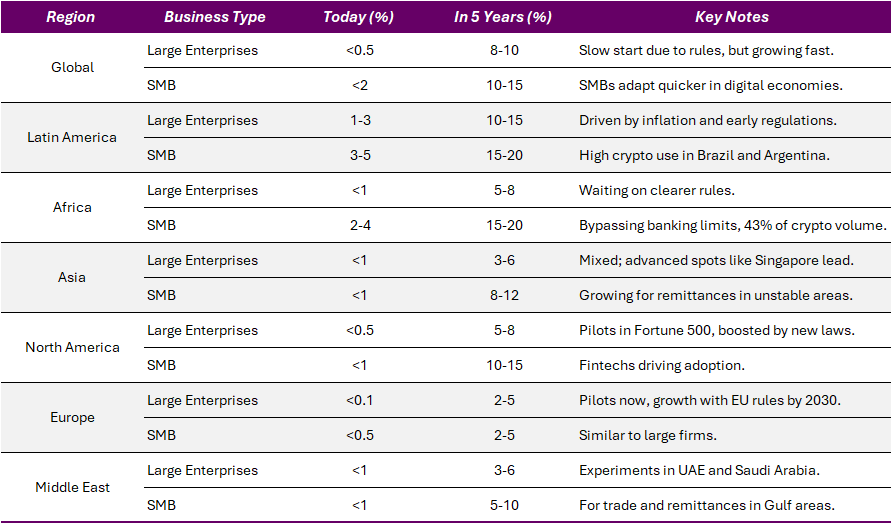
Global stablecoin trading hit $23 trillion in 2024, with $2 trillion in cross-border flows, especially high relative to economy size in Africa, Middle East, and Latin America. Source: Bitso, IMF, Coingecko & Coindesk.
Outlook: Toward a Stablecoin-Driven Financial Future
As stablecoins mature, their ability to address pain points in payments, from speed and cost to accessibility, positions them as a cornerstone of modern finance. With regulatory tailwinds like the GENIUS Act and regional frameworks fostering innovation, adoption is poised to accelerate, particularly in emerging markets where they already handle significant remittance shares. Consider blockchain technology’s parallels to mobile phones: the GENIUS Act is akin to the law authorizing mobile phone production, providing foundational legitimacy, while the upcoming CLARITY Act represents the legislation enabling antenna infrastructure, unleashing widespread connectivity and industry expansion.
Financial institutions and businesses must navigate remaining challenges, but the data suggests a transformative trajectory, potentially redefining global economic interconnectivity.